
CHIP or the Children's Health Insurance Program
- Gives qualified children access to health insurance through distinct CHIP and Medicaid programs.
- Children from households with incomes too high to be eligible for Medicaid but too low to purchase private insurance are eligible for CHIP.
- It is overseen by states in compliance with federal regulations.
- It is financed by both the federal government and the states.
Understand the Differences between Medicaid and CHIP
Understanding Medicaid Coverage for Low-Income Families
The Significance of Medicaid Expansion for You
Verifying CHIP - Increasing Low-Income Children's Health Coverage
Differentiate CHIP and How Is It Different?
Goal and Target Audience
Top Techniques for Effective Pediatric Medicaid and CHIP Billing
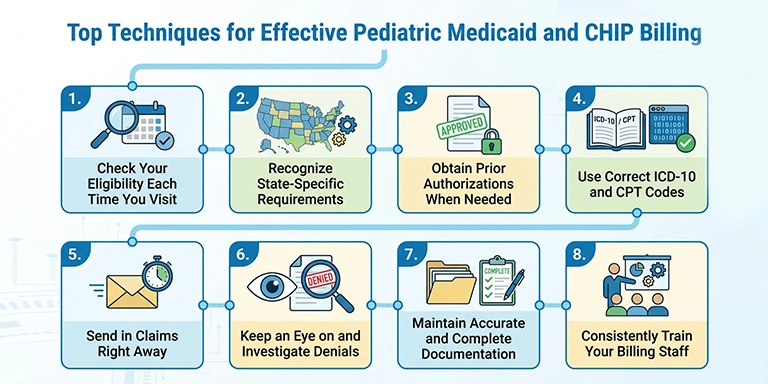
1. Check Your Eligibility Each Time You Visit
Verify a child's Medicaid/CHIP eligibility before every appointment, even if they are a repeat patient. To prevent claim denials because of inactive coverage, use the eligibility verification portal provided by your state.
2. Recognize State-Specific Requirements
You must be aware that billing codes vary by practice. Assign a staff member to stay up to date on pediatric Medicaid and CHIP billing regulations in your state. For instance, ensure your ICD-10 codes align with the appropriate E/M codes for pediatric visits.
3. Obtain Prior Authorizations When Needed
Always determine whether prior authorization is necessary for services like therapy, procedures, or specialty referrals. If this step is skipped, claims may be rejected, and money may be lost.
4. Use Correct ICD-10 and CPT Codes
Correct coding is crucial. Modifier codes are frequently needed for pediatric-specific services to specify the patient's age or service type. For instance, ensure your ICD-10 codes accurately reflect the child's health and use the appropriate E/M codes for pediatric visits.
5. Send in Claims Right Away
Strict claim filing deadlines, typically ranging from 90 to 180 days from the date of service, apply to many Medicaid programs. Late submissions may be automatically rejected with no chance of appeal.
6. Keep an Eye on and Investigate Denials
Examine the Explanation of Benefits (EOB) to find out why a claim was rejected. Typical justifications for denial include:
- Inaccurate Patient Eligibility
- Absence of Previous Authorization
- Erroneous Coding
- Appeal as Soon As Possible to Prevent Losing Money
7. Maintain Accurate and Complete Documentation
Keep thorough records of the following for compliance and auditing purposes. During state Medicaid audits, this safeguards your practice.
- Medical necessity
- Previous permissions
- Clinical observations
8. Consistently Train Your Billing Staff
You can consistently conduct ongoing training for your billing staff. Additionally, by partnering with a reliable healthcare provider to optimize the billing operations of Medicaid and CHIP, your healthcare can experience smart billing. This ensures compliance with all Pediatric medicaid Texas.
Conclusion
About the Author

Elena Kinsley is a seasoned Content Strategist and Chief Technology Officer (CTO) specializing in medical revenue cycle management (RCM).